Justice sensitivity isn’t a flaw in my character; it’s a nervous system shaped by empathy, experience, and the cost of unfairness.
I’ve made a couple of videos about Justice Sensitivity on my YouTube and TikTok channels because I think it’s a significant experience that gets us ADHDers into a lot of trouble simply because it’s not understood.
Or perhaps, more correctly, it is often misunderstood.
Justice Sensitivity is something I’ve experienced all my life, which means I’ve lived with it for 62 years. For 61 of those years, I lived with it as an undiagnosed ADHDer.
The signs were there from a very early age. As a young child, I was acutely aware of human rights and would often bring kids from school to my Mum for a meal, knowing they weren't eating much at home. I felt for animals and the way they were mistreated and worse, eaten by us human beings. I was a kid in a time when whole pigs would hang from hooks in the butcher's window, and this would make me physically sick. I could not understand why it was considered acceptable to do this to other animals, yet not to humans. Why would the life of a lamb attract less value than that of a human child? I knew animals felt fear, pain, and loneliness as much as humans did, just by looking into their eyes.
Our neighbours' children were mixed race; their white mother had married a black man. It never once occurred to me to treat them differently. They played with my sister and me most weekends, yet I knew they suffered at school, and that hurt me terribly.

In my very early teens, I became glued to the BBC News, where John Cole, the BBC Political Editor, taught me politics. I was outraged by inequality, appalled at how one's social and economic background seemed to determine one's life chances, and became known as Red Robbo at school, the media nickname given to Derek Robinson, who, as a Union Convenor at British Leyland, famously led 523 walkouts during a 30-month period. I was proud to carry that label.
I received many other labels over the years: overemotional, campaigner, outspoken, wag, argumentative, opinionated, arrogant. The labels came thick and fast.
Now I look back, and I see an undiagnosed ADHDer living with Justice Sensitivity. I feel injustice in the same way that I feel my breath travelling through my body. It can be like a fire burning out of control, and when I act without awareness, others may feel I am expressing anger or resistance when my motivation stems from unbearable pain.
ADHD brains often show heightened emotional reactivity and a more sensitive threat detection system. The amygdala can activate quickly in response to perceived unfairness or harm, triggering a strong bodily response before the prefrontal cortex has time to evaluate context or nuance.
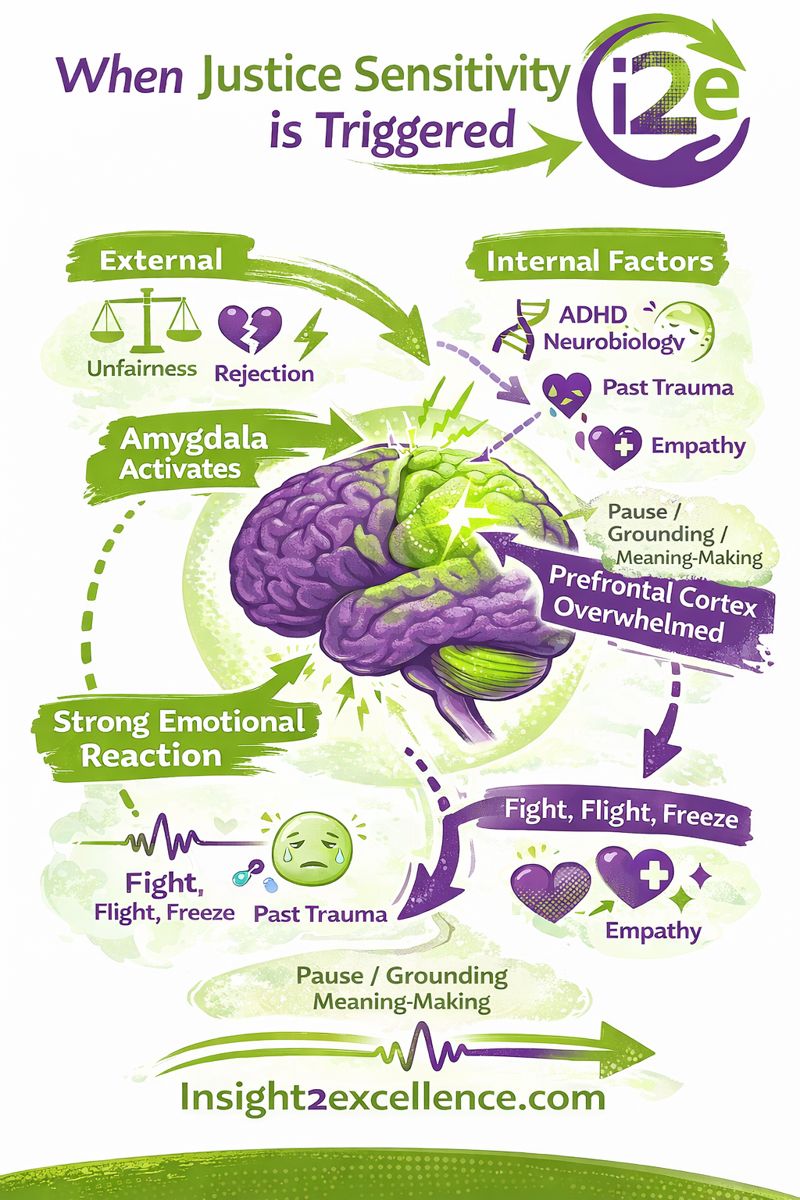
Differences in dopamine regulation mean ADHD nervous systems are more driven by meaning, values, and emotional salience than by abstract rules. When something violates a deeply held sense of fairness, it registers not just as a moral concern but as a nervous system event.
This is why justice sensitivity is often felt physically. Tightening in the chest, heat, agitation, or an urge to act can arise automatically. These responses are not a failure of reasoning, but the result of a brain wired for intensity, empathy, and rapid emotional signalling.
For me, this neurobiology didn’t develop in a vacuum. Growing up as a queer person in a religious context where love felt conditional and identity was framed as wrong or dangerous, shaped my nervous system profoundly. When rejection, moral judgment, or exclusion are repeated early on, the brain learns to stay alert for threat. Over time, fairness and justice become closely linked with safety and survival.
What looks like heightened sensitivity in adulthood is often the nervous system remembering what it once cost to be unseen, silenced, or spiritually shamed. In that sense, this sensitivity is not just about values; it is about protecting dignity, truth, and the right to exist without harm.
All of this shaped the direction of my working life. A nervous system attuned to unfairness, exclusion, and misuse of power naturally drew me towards social care, where the stakes are human, and the consequences of injustice are real. For forty years, I found myself noticing who was being unheard, who was being controlled rather than supported, and who was carrying blame for systems that had failed them. Again and again, I felt compelled to speak up or step in, not because I wanted conflict, but because my body would not let me ignore harm.
When I stood up for a member of staff against a huge Local Government department, my manager said, “He’s a member of staff, yet you are treating him like a service user.” I replied that I didn’t know human rights depended upon one's employment status.
That same sensitivity continues to inform my work as an ADHD coach, where advocacy, dignity, and autonomy sit at its heart.
There are moments when acting on behalf of others has come at a personal cost, but I do not regret the instinct to protect, to name what is wrong, and to stand alongside those with less power. It’s just that now I choose to do so in awareness – or at least, that is my aim. I don’t always get it right!
Justice Sensitivity is about being sensitive.
For me, the work is learning when to trust that signal and when to pause, regulate my nervous system, and respond rather than react.
This is the stuff of practice.