Being diagnosed with ADHD as an adult is a unique experience.
When I was first diagnosed with ADHD, I experienced an identity crisis. What I have discovered in my work as an ADHD Coach is that, whilst not universal by any means, many people experience this when diagnosed later in life.
I have come to see that the Post-Diagnosis Identity Crisis is real, profound, and deeply moving. For the outsider, ADHD is simply another label, and one that people increasingly meet with dismissiveness (someone said to me recently, “I think I’m the only person I know who doesn’t have ADHD”). For the person receiving the diagnosis, far from being yet another medical label, it’s like being handed a new lens to look at your entire past. This can be deeply unsettling.
Suddenly, those things you identified with for decades, your personality, your ‘procrastination,’ your ‘flaws’, or your ‘quirks,’ might not actually be you at all, but traits of neurological wiring. Worse still, these traits are often described as “symptoms,” reinforcing a sense of something being wrong with you.
For many, this is deeply disturbing. The “Who am I?” question can be terrifying, not least because our frame of reference feels external rather than internal.
There are many reasons we ADHD folk feel a disconnect with our intrinsic self:
Many of us spend years trying to fit in, actively and consciously working to suppress those parts of us we are convinced others see as weird. We project onto the world a character we believe is socially acceptable. Instead of living our lives, we perform, and our connection with who we really are fades and eventually evaporates.
We believe the character we have created is us.
Many of us have lived through decades of teachers, parents, siblings, peers, and bosses telling us that we are failing to fulfil our potential. That if only we paid attention, stopped being so distracted, focused, employed some concentration and ‘knuckled down,’ we would actually make something of our lives. In time, this acts as a self-fulfilling prophecy; we believe and accept the version of us that others present and internalise those labels. In a very real way, we didn’t get to decide who we are; we simply adopted these labels because we didn’t have a better explanation.
ADHD brings several social challenges. In conversations, we may go off topic and feel that we’re “rambling.” We may struggle with social cues and reading the emotional tone of a conversation. We may act before thinking, especially when we feel we need to fix a situation. Our impulsivity can come at a high personal cost. We can struggle managing intense emotions, perceive rejection at every turn, and have a very remote relationship with time.
These are significant and often misunderstood traits, and for those of us diagnosed as adults, we will have spent years confused and embarrassed by them. We deal with this by becoming social chameleons; we mirror how others act and engage, adapting our personality to whoever we are with in a bid to fit in and feel safe and connected. I well remember my mum saying one day:
“Will the real Andy Robinson please stand up!”
The net result is that when we are handed our adult diagnosis, we feel that the blank page on which others have written their versions of us has suddenly been erased. We feel lost, disoriented, and scared that there’s nothing behind the mask. It can actually feel like an existential crisis.
But whilst this may feel like a crisis, it’s also an invitation.
You can think of it this way. For years, you were forced to play the piano, you attended years of classes, yet it never worked for you. Then one day, you picked up a violin and something clicked. You found your niche, your calling. Your gift. It wasn’t that you were bad at the piano; you were just a violinist being told you were a bad pianist.
ADHD is a neurological trait, one of many. It doesn’t define you; it’s simply the way you navigate the world. It doesn’t define why you care about the things you do. The “Who Am I?” is the person who survived without knowing the rules of the game.
That person is deeply resilient, empathetic, and creative.
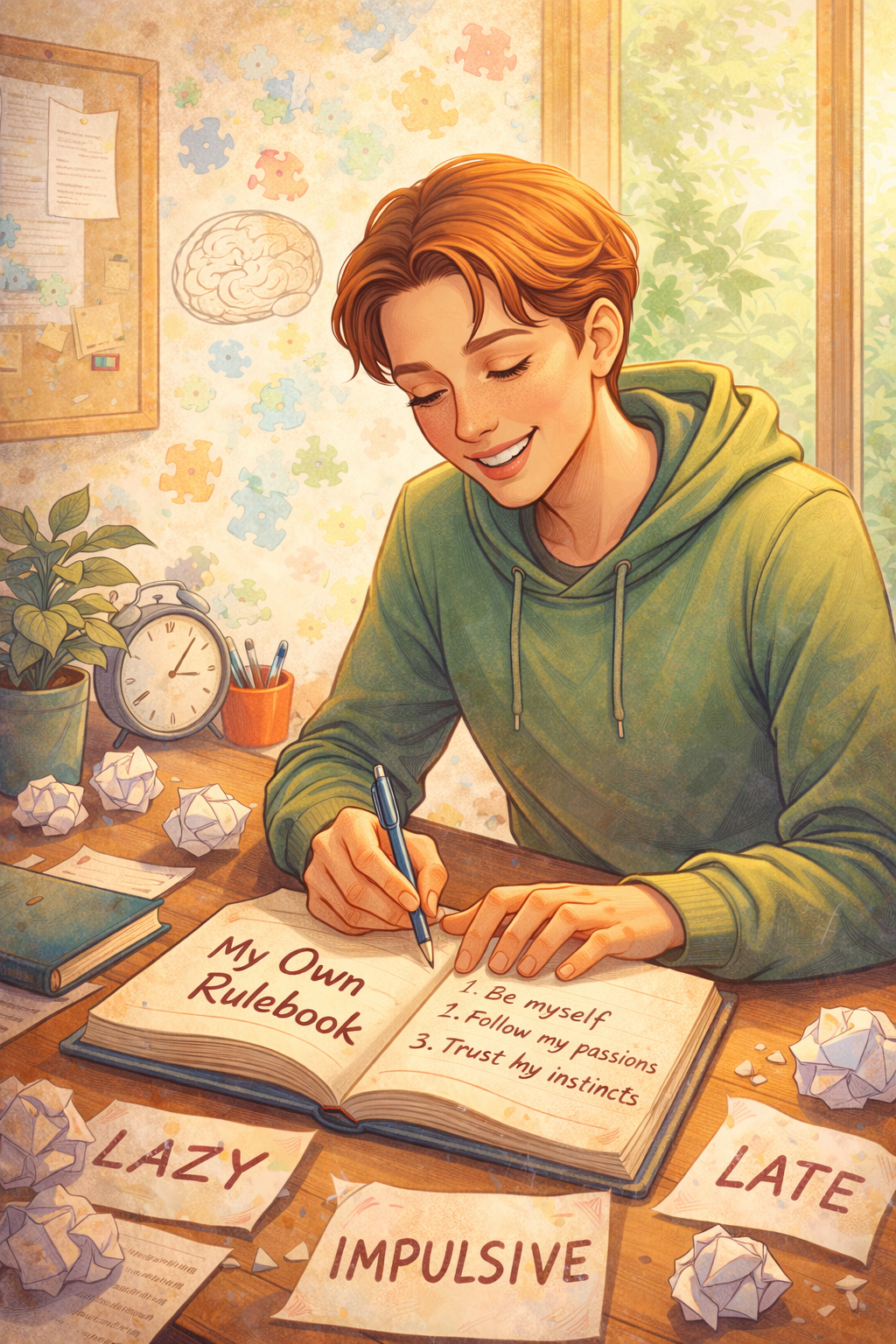
Now you get to write your own rule book.